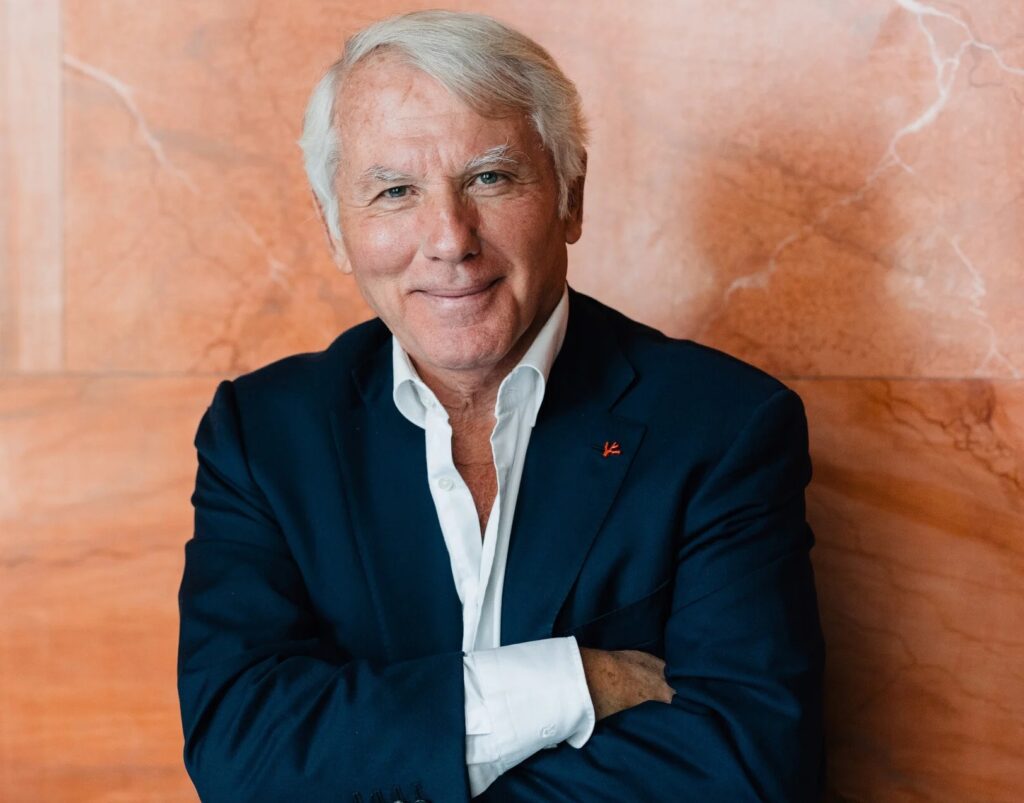
Name: Dimitri V. Nanopoulos
Professional Title: Distinguished Emeritus Professor of Physics
Institutional Affiliations: Texas A&M University; New York University; CERN; Founder, Nanopoulos Foundation Inc. (NYC, USA); Founder, Nanopoulos Center for Science and Society (Greece)
Geographic Base: New York, USA
Short Bio:
Dimitri V. Nanopoulos is one of the most influential theoretical physicists and cosmologists of our era, whose pioneering contributions have profoundly shaped modern particle physics, quantum cosmology, and interdisciplinary studies of consciousness. Over more than three decades at CERN, he collaborated with John Ellis and Mary Gaillard to develop the theoretical framework that directly guided the experimental discovery of the Higgs boson, a milestone recognized by Professor Peter Higgs himself.
Nanopoulos’ research spans the infinitesimal and the cosmological, uniting quantum theory, particle physics, cosmology, and pioneering investigations into the “quantum brain.” He has authored over 767 original scientific publications and 15 books, accumulating more than 57,000 citations. According to the 2000 and 2004 Stanford University global citation rankings, he was recognized as the fourth most cited theoretical physicist worldwide. His research has been supported with multi-million-dollar grants from the U.S. Department of Energy, and he has served on high-level advisory panels, including a NASA-appointed committee overseeing $600 million in foundational scientific research.
A visionary at the intersection of science and society, Nanopoulos founded the Nanopoulos Foundation Inc. (New York) and the Nanopoulos Center for Science and Society (Greece), championing interdisciplinary research, science education, and public engagement. In 2011, he was one of only 25 cosmologists worldwide invited to a closed conference at the Vatican Observatory, contributing to global debates on the philosophical and scientific dimensions of cosmology.
His exceptional career is further distinguished by numerous honors: Fellow of the American Physical Society (1988), Member of the Italian Physical Society (1992), Commander of the Order of Honour of the Greek State (1996), and recipient of the Enrico Fermi Award (2009). Through his unparalleled scholarship, leadership, and global influence, Dimitri V. Nanopoulos continues to advance fundamental science while bridging the dialogue between the microcosmos, the macrocosmos, and society at large.
Professor Dimitri Nanopoulos is internationally recognized as one of the most influential theoretical physicists of his generation, with pioneering contributions across particle physics, cosmology, string theory, and unified field theories.
Date of Birth: 13 September 1948
Place of Birth: Athens, Greece
Education
B.Sc. in Physics, University of Athens (1971)
Ph.D. in High-Energy Physics, University of Sussex, UK (1973)
Doctoral research focused on theoretical models in particle physics and quantum field theory.
Academic & Research Appointments
Early Career
Research Fellow, CERN, Geneva
Research Fellow, École Normale Supérieure, Paris
Research Fellow, Harvard University, USA
Texas A&M University (USA)
Professor of Physics (1989–2019)
Distinguished Professor of Physics (1992–2019)
Mitchell/Heep Chair in High-Energy Physics (2002-2019)
Distinguished Emeritus Professor of Physics (2019-present)
Leadership Roles
Head, Astroparticle Physics Group, Houston Advanced Research Center (HARC) (1989-2023)
Full Member, Academy of Athens (elected 1997)
Vice-President, Academy of Athens (2014)
President, Academy of Athens (2015)
National & International Representation
Greek National Representative at CERN (multiple terms, 2005–2015)
Greek National Delegate to the European Space Agency (ESA) (2005–2006)
Chairman, Greek National Council for Research & Technology (2005–2009)
Research Areas & Scientific Contributions
Professor Nanopoulos’ scientific work spans a broad range of fields:
Core Areas
High-Energy Particle Physics
Supersymmetry & Supergravity
String Theory & Unified Theories
Quantum Cosmology
Astroparticle Physics
Early Universe Models
Landmark Contributions
Co-developer of the “flipped SU(5)” Grand Unified Theory, a major alternative to traditional GUT models.
Early theoretical work that directly contributed to the framework predicting the Higgs boson, later confirmed experimentally at CERN.
Foundational studies merging string theory with cosmological models of the early universe.
Exploratory theoretical work in quantum-inspired models of brain function, connecting physics with biological information processing.
Publications & Scholarly Impact
Over 760 peer-reviewed research papers
Author of 15 scientific books
More than 57,000 citations, h-index-112
Routinely listed among the world’s most highly cited theoretical physicists
His prolific output positions him as one of the leading figures in contemporary theoretical physics.
Selected Honors & Awards
Fellow, American Physical Society (1988)
Member, Italian Physical Society (1992)
Commander of the Order of Honour, Hellenic Republic (1996)
1st place award from the Gravity Research Foundation (Massachusetts, U.S.A.) (1999)
1st place award from the Gravity Research Foundation (Massachusetts, U.S.A.) (2005). Received for the 2nd time on the occasion of the 100th anniversary of the Einstein’s Relativity Theory.
Onassis International Prize (2006)
Included in the List of 100 Great Greeks of all time (2008)
Enrico Fermi Prize, Italian Physical Society (2009)
International Foundation for Greece (IFG) Award for enhancing the international presence of Greece in the field of Science. In this context Hellenic Post included him in the new commemorative stamp series featuring distinguished Greek personalities (2019).
Recognized in numerous international citation rankings as among the top global contributors in high-energy physics
International Activities & Advisory Roles
Consultant and advisor to numerous scientific committees in Europe and the United States.
Organizer and keynote speaker at major international conferences in physics and cosmology.
Contributor to global scientific dialogues on the future of physics, the nature of the universe, and interdisciplinary approaches to complex systems.
Legacy & Influence
Professor Nanopoulos has shaped the trajectory of modern theoretical physics through his:
Foundational contributions to unified theories, including:
-Proposed the way to produce and observe the Higgs particle at the colliders in 1975-76, that led to the discovery of the Higgs particle at the LHC, CERN in 2012. [1,2]
-Proved that the LEP data suggest unification of the strong, weak and electromagnetic coupling constants at very high energies, close to the Planck Scale (MUNIF16 Gev). [3,4]
-Suggested that Suppersymmetric relics from the Big Bang, including the neutralino, fit the bill to be the long sought Dark Matter. [5]
-Discovered No-Scale Supergravity, [6,7,8] a unique framework that provides a natural vanishing cosmological constant, at the classical level, in N=1 Supergravity, that eventually proven to be the low-energy limit of String Theory.
-Proposed a String derived Unified Theory, at 4-dimensions [9,10,11], based on Flipped SU(5) [12,13], that has amazing success in Particle Physics and Cosmology.
-Proposed specific experiments, involving gamma ray bursts, that may check the radical proposal that he and his collaborators proposed in 1997, that the velocity of light may have some dependence on the frequency (aka “color”) of “light” [14].
-Quantum Brain? Based on work more than 30 years ago [15,16,17,18,19,20], we proposed recently [21] a new model that shows how networks of protein-based microtubules could host entangled quantum states under normal biological conditions. Such structures may enable scalable, ambient-temperature quantum compilation, with the fundamental unit of information storage realized as a quDit, (D=4), encoded in the tubulin dipole state. [21] If experimentally confirmed, this model could open entirely new avenues toward biological Quantum Computers, potentially more resilient to information loss than current technologies.
Leadership roles in national and international research institutions
Mentorship of generations of physicists
Commitment to promoting scientific excellence in Greece and abroad
His work continues to influence contemporary physics, inspire global collaborations, and push the boundaries of our understanding of the universe.
References
[1] Ellis, John R., Mary K. Gaillard, and Dimitri V. Nanopoulos. “A Phenomenological Profile of the Higgs Boson.” Nuclear Physics B 106 (1976): 292. First published October 1975.
[2] Georgi, H. M., S. L. Glashow, M. E. Machacek, and Dimitri V. Nanopoulos. “Higgs Bosons from Two Gluon Annihilation in Proton–Proton Collisions.” Physical Review Letters 40 (1978): 692. First published December 1977.
[3] Ellis, John R., S. Kelley, and Dimitri V. Nanopoulos. “Precision LEP Data, Supersymmetric GUTs, and String Unification.” Physics Letters B 249 (1990): 441–448. First published June 1990.
[4] Ellis, John R., S. Kelley, and Dimitri V. Nanopoulos. “Probing the Desert Using Gauge Coupling Unification.” Physics Letters B 260 (1991): 131–137. First published November 1990.
[5] Ellis, John R., J. S. Hagelin, Dimitri V. Nanopoulos, Keith A. Olive, and M. Srednicki. “Supersymmetric Relics from the Big Bang.” Nuclear Physics B 238 (1984): 453–476. First published July 1983.
[6] Cremmer, E., S. Ferrara, C. Kounnas, and Dimitri V. Nanopoulos. “Naturally Vanishing Cosmological Constant in N = 1 Supergravity.” Physics Letters B 133 (1983): 61. First published July 1983.
[7] Ellis, John R., A. B. Lahanas, Dimitri V. Nanopoulos, and K. Tamvakis. “No-Scale Supersymmetric Standard Model.” Physics Letters B 134 (1984): 429. First published September 1983.
[8] Lahanas, A. B., and Dimitri V. Nanopoulos. “The Road to No-Scale Supergravity.” Physics Reports 145 (1987): 1. First published May 1986.
[9] Antoniadis, Ignatios, John R. Ellis, J. S. Hagelin, and Dimitri V. Nanopoulos. “The Flipped SU(5) × U(1) String Model Revamped.” Physics Letters B 231 (1989): 65–74. First published July 1989.
[10] Antoniadis, I., Dimitri V. Nanopoulos, and J. Rizos. “Cosmology of the String-Derived Flipped SU(5).” Journal of Cosmology and Astroparticle Physics 03 (2021): 017. First published November 18, 2020. arXiv:2011.09396 [hep-th].
[11] Antoniadis, Ignatios, Dimitri V. Nanopoulos, and John Rizos. “Particle Physics and Cosmology of the String-Derived No-Scale Flipped SU(5).” European Physical Journal C 82, no. 4 (2022): 377. First published December 2, 2021. arXiv:2112.01211 [hep-th].
[12] Derendinger, J. P., Jihn E. Kim, and Dimitri V. Nanopoulos. “Anti-SU(5).” Physics Letters B 139 (1984): 170–176. First published November 1983.
[13] Antoniadis, Ignatios, John R. Ellis, J. S. Hagelin, and Dimitri V. Nanopoulos. 1987. “Supersymmetric Flipped SU(5) Revitalized.” Physics Letters B 194: 231–235.
[14] Amelino-Camelia, G., John R. Ellis, N. E. Mavromatos, Dimitri V. Nanopoulos, and Subir Sarkar. 1998. “Tests of Quantum Gravity from Observations of Gamma-Ray Bursts.” Nature 393: 763–765. https://doi.org/10.1038/XXXX. Preprint, arXiv:astro-ph/9712103.
[15] Nanopoulos, D. V. “Invited Plenary Talk at the 1st International High-Energy Physics Conference: The Four Seas Conference—Physics without Frontier, ENFPC 1994.” arXiv:hep-ph/9505374 [hep-ph], 1995.
[16] Mavromatos, N. E., and Dimitri V. Nanopoulos. “A Noncritical String (Liouville) Approach to Brain Microtubules: State Vector Reduction, Memory Coding and Capacity.” arXiv:quant-ph/9512021 [quant-ph], December 1995.
[17] Mavromatos, N. E., and D. V. Nanopoulos. “A Non-Critical String (Liouville) Approach to Brain Microtubules: State Vector Reduction, Memory Coding and Capacity”, International Journal of Modern Physics B 11 (1997): 851. https://doi.org/10.1142/S0217979297000460.
[18] Mavromatos, N. E., and Dimitri V. Nanopoulos. “On Quantum Mechanical Aspects of Microtubules.” International Journal of Modern Physics B 12 (1998): 517. arXiv:quant-ph/9708003 [quant-ph], August 1997.
[19] Mavromatos, N. E., and D. V. Nanopoulos. “Quantum mechanics in cell microtubules: Wild imagination or realistic possibility”, Advances in Structural Biology 5 (1998): 283. https://doi.org/10.1016/S1064-6000(98)80015-X
[20] Mavromatos, N. E., A. Mershin, and D. V. Nanopoulos. “QED-Cavity Model of Microtubules Implies Dissipationless Energy Transfer and Biological Quantum Teleportation.” International Journal of Modern Physics B 16 (2002): 3623–3642. arXiv:quant-ph/0204021. https://doi.org/10.1142/S0217979202011512
[21] Mavromatos, Nick E., Andreas Mershin, and Dimitri V. Nanopoulos. “On the Potential of Microtubules for Scalable Quantum Computation.” European Physical Journal Plus 140, no. 11 (2025): 1116. First published May 26, 2025. arXiv:2505.20364 [physics.bio-ph].